There's one question I've been puzzling over: how can you tell whether someone who knows more than you is right? It's fast becoming one of the most important questions we face, now that AI is producing mathematics hardly anyone alive can check. Socrates wrestled with it constantly, and I think his best answer is in a short dialogue called the Euthyphro.

A son against his father
The year is 399 BC, and Socrates is waiting outside the office of the King Archon in Athens, for the preliminary hearing in his own case. The charge? Impiety, and it will cost him his life a few weeks later.
There he bumps into Euthyphro, a self-styled religious expert, who is on his way in to prosecute his own father for murder. Here's what happened: (1) a labourer on the family farm killed a slave in a drunken fight; (2) Euthyphro's father tied him up, threw him in a ditch, and sent to ask what should be done; then (3) the man died of cold and hunger before the messenger came back.
To most Athenians, prosecuting your own father was itself an act of impiety. But Euthyphro disagrees: piety, he says, means punishing wrongdoers whoever they are, family or not. After all, didn't Zeus himself chain up his own father Kronos? Socrates is (or pretends to be) impressed: only a man "far advanced in wisdom," he says, would dare do such a thing. And he has a personal stake. He's facing exactly this charge himself, so he'll become Euthyphro's student, he says, and use what he learns in his defence. So Socrates asks the obvious question: if Euthyphro is the expert, then what is piety?
How the elenchus works

What follows is the elenchus, Socrates' characteristic method of cross-examination. Here's how it works:
- You offer a definition.
- Socrates gets you to agree to a few other things that seem obviously true.
- He shows you that your definition and those other things can't all be true at once, so something has to give.
Euthyphro's first answer is that piety is "what [he's] doing now, prosecuting wrongdoers." That fails before the test even begins: it's one example, not a definition, and Socrates wants the one feature that makes every pious act pious.
So Euthyphro tries again: piety is "what the gods love" (step 1). Now Socrates' refuting-machine starts up. Euthyphro also believes the gods quarrel, and they quarrel about what is just and good (step 2). So the same act will be loved by some gods and hated by others, which makes it pious and impious at the same time (step 3). Defeat for Euthyphro. He tries to patch it: piety is what all the gods love.
Then comes the famous question: is the pious loved by the gods because it is pious, or is it pious because it is loved? Euthyphro picks the first, and it's easy to see why: if things were pious simply because the gods loved them, the gods' love would be arbitrary. They could love anything at all. So the gods must love pious things because of something about them. But then again, "loved by the gods" can't be what piety is. It's like an examiner's mark: excellent evidence that an essay is good, but certainly not what makes it good. (Socrates calls this a pathos rather than the ousia, the essence.) A couple more attempts to define piety follow and go round in circles, until Euthyphro suddenly (and conveniently) remembers he has somewhere to be.
The puzzle
Here's the puzzle that has bothered readers these past two and a half millennia. Socrates is famous for claiming ignorance. In the Apology, comparing himself with a man reputed to be wise, he says: "he knows nothing, and thinks that he knows; I neither know nor think that I know." So how can he tell that Euthyphro's answers are wrong? That is, surely you need to know what piety (or anything) is to see that someone has misunderstood it.
I think the answer comes in two parts. The first is that Socrates never uses his own beliefs. Every premise he relies on is one Euthyphro has granted. That means he isn't saying "you're wrong because piety is X," but rather "you can't reasonably believe all of these things at once."
The second part is more interesting. Socrates doesn't know what piety is, fine, but he does know something: what a good answer would have to look like. And each of Euthyphro's answers fails one of his tests:
- A good answer must cover every pious act, not just one. "What I'm doing now" is only one example.
- A good answer mustn't make the same act both pious and impious. "What the gods love" fails because the gods disagree.
- A good answer must give the reason something is pious, not just a sign that it is. "What all the gods love" is just evidence of piety.
The upshot: Socrates lacks first-order knowledge (= what piety is) but has second-order knowledge (= what any account of piety must be like). That is, he can know the shape of an answer without knowing the answer itself, and that's sufficient to rule most answers out.
What Socrates can't do
There is, of course, a catch. Gregory Vlastos called it "the problem of the elenchus," and it's hard (impossible?) to get around. Socrates' method only ever shows that a set of beliefs is inconsistent: it can't show which belief is false, still less what the truth is!
Imagine Euthyphro had simply bitten the bullet. "Yes, the gods never disagree" (even if myth suggests otherwise) and "yes, piety just is whatever they love" (even if that makes it arbitrary). Socrates would have struggled to catch him. The more consistent you are, the harder you are to refute, even if you're horrifically wrong.
So why did Socrates keep at the elenchus? Maybe he trusted that, pushed far enough, people's true beliefs win out: that anyone who holds a false belief also holds true ones that contradict it, which questioning can bring to the surface. Even so, that takes time; and Plato's early dialogues only ever show the first stage. They end in aporia instead of an answer, "no way through": the interlocutor discovers that the beliefs they were so sure of can't all be true together. For Socrates, I think that was where real inquiry could begin. But Euthyphro, who dashes off, doesn't stay to find out.
Why this matters now
I don't believe that this puzzle is limited to Socrates and the Greeks. Last Friday, Levent Alpöge, a mathematician at Anthropic, posted a four-page note: "I believe I have, working with Claude, discovered a proof of the Riemann Hypothesis." The hypothesis, first posed in 1859, is probably the most famous open problem in mathematics. What makes the claim so striking is its form: where for centuries there would have been a paper for mathematicians to read, now there is only computer code, and lots of it: 175,187 files (?!) written in Lean, a language in which a small program checks every logical step. Within a day, the Lean community had checked it and declared both the statement and the proof correct.
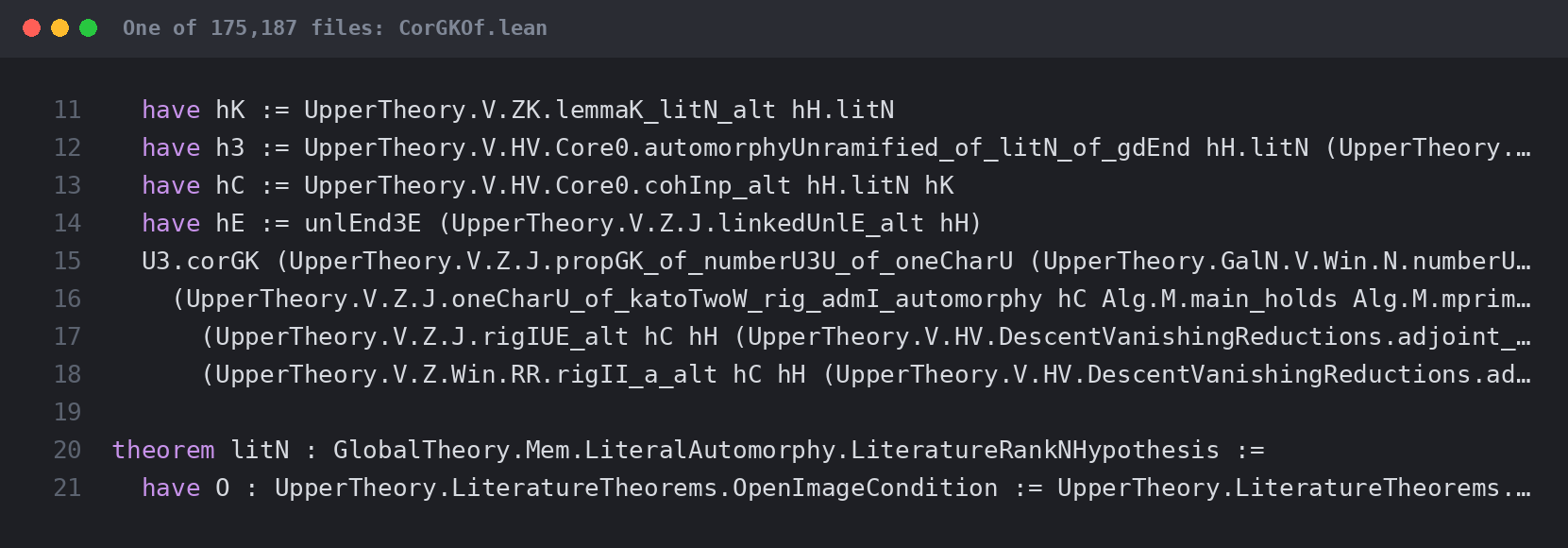
So we now seem to know that the Riemann hypothesis is true, without anyone yet really understanding why. (It might take years for us to work out how the argument fits together.) So in maths, at least, we've found a way past Socrates' catch: Lean tests more than whether the claims hang together; it also checks that every step really follows from the last. A consistent liar can't fool it.
But I ask myself: what would Socrates say? And I suspect he'd be unsatisfied. The proof contains every step, so in principle the why is all there, but no human can yet hold it in their head. For now, the certificate works a little like the gods' approval in the Euthyphro: excellent evidence that something is true, without anyone grasping what makes it so. Socrates wanted that understanding, and so, it seems, do today's mathematicians.
And, of course, most of life isn't maths. When an AI advises you (on health, say, or your money, or even a moral question), there's no Lean to check it with. We're back with something like the elenchus, and back with Vlastos' problem: a perfectly consistent fool (or liar…) is very hard to catch. I suggest we also take the trial of Socrates as a potent warning: the jury was swayed by whoever spoke more persuasively, and they got it badly wrong. Working out how a weaker mind can rightly trust a stronger one has to be one of the big questions of the next few decades, and I think ancient philosophy is as good a start as any.
This essay first appeared in Antiquitas, my weekly newsletter.