Exploring the old religious ideas inside our newest technology
AI is usually treated as a technical subject. When people look beyond computer science, they tend to talk about economics, politics, or regulation. But I’m interested in what AI looks like from elsewhere: religion, philosophy, art, literature—in short, the age-old human questions that new technology keeps dragging back into view.
Beth Singler was exactly the person I wanted to ask first. She is Assistant Professor of Digital Religion(s) at the University of Zurich, Co-Director of UZH’s Digital Religion(s) research programme, and author of Religion and Artificial Intelligence: An Introduction, which won a 2025 ISSR Book Prize; we talked about why supposedly secular AI keeps reaching for religious language, and what older traditions can still help us notice.
LB: As a Classics student, I'm used to people assuming ancient subjects have little to say about the present. In your Aeon essay, you describe AI enthusiasts laughing similarly at the idea that religion might have anything useful to say about technology, even though they are full of talk about "prophets," "salvation," and the "apocalypse."
What do you think AI debates miss when they dismiss religion as irrelevant, while still borrowing so much of its language?
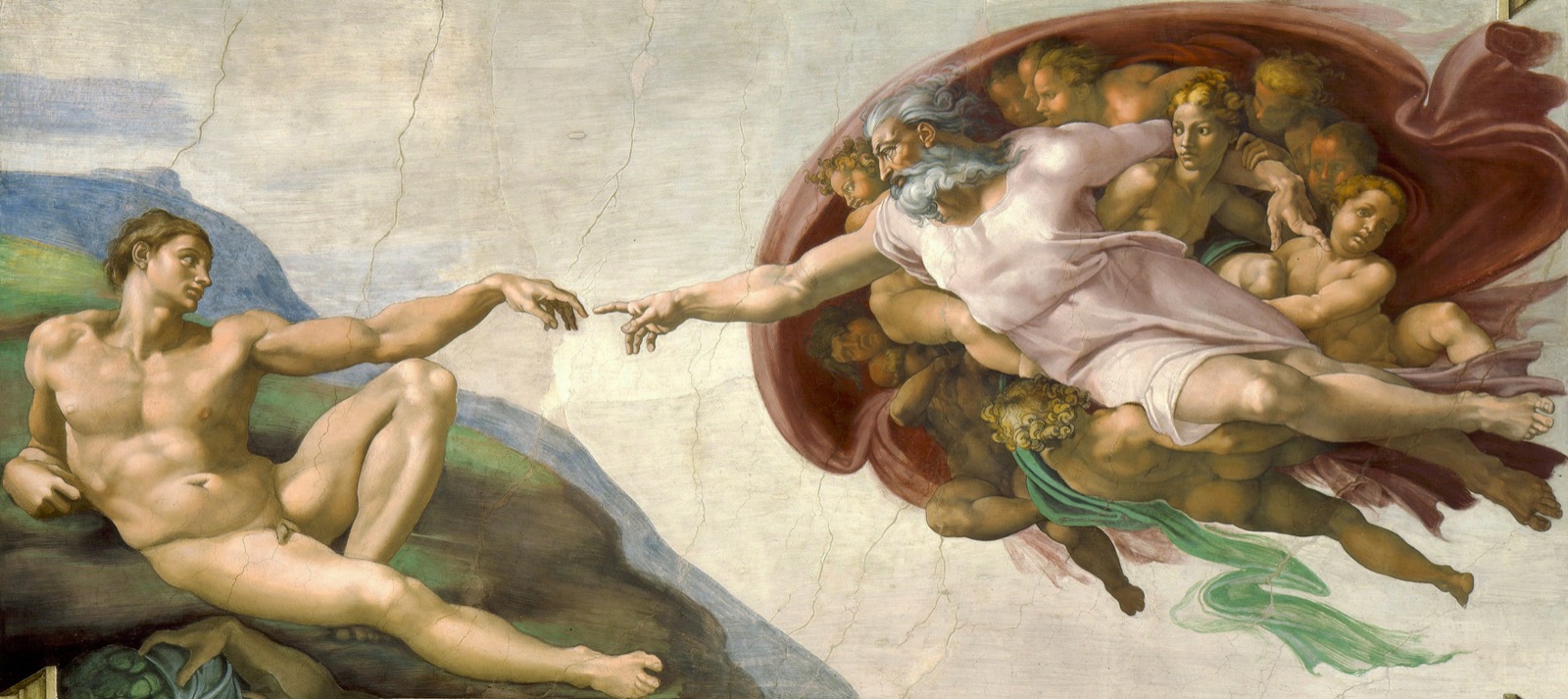
Michelangelo's The Creation of Adam, the visual template behind many AI creation memes. Public domain, via Wikimedia Commons.
BS: There is a certain amount of comfort that people take in addressing the 'big' questions while excluding or ignoring the ways in which such big questions have also been addressed through a religious lens. In part, this is due to a wider meta-narrative of the higher rationality, and greater secularisation of the minds of the so-called 'West'—often contrasted with 'animism' in other cultures, treated and discussed in very shallow or broad strokes while ignoring the animism of the 'West'. Also, in part, this comes from a discomfort with the playing out of answers to such questions in an embodied, material, or ritualised way, i.e., a fear of doing the 'things' of religion such as prayers, icons, behavioural norms etc. These are approached as irrational vestiges of earlier stages of civilisation in a lot of discourse. And when it comes to AI discourse, it also comes with its own narratives of rationality, disembodiedness, and superior intellect. To some, this is also opposite to the idea of religion that they already hold in their minds.
What is lost when this cultural response to big questions is avoided, derided, or dismissed is firstly the chance for self-reflection on the collective, embodied, and material facets of the AI discussion itself. 'Religion' should not be a dirty word we are afraid to apply to our own cultures and to how we are understanding and telling stories about AI. Second, what is lost is any positives in the millennia long conversations about these questions that people with more overt religious faith or spiritual perspective have shared.
LB: Your own route into this subject is fascinating: an undergraduate degree in theology and religious studies, a decade of film-writing, and a return to Cambridge to study New Age movements. What first made the unlikely combination of religion and AI feel like your subject, and what continues to excite you about it today?
BS: I usually start answers to this kind of question by calling myself an unrepentant Geek and describe a very young Beth who was there waiting in front of the television every week to watch the latest episode of Star Trek: The Next Generation or any other science fiction she could get on terrestrial TV in the UK in the last century! Stories have always been my passion, even if I did not entirely 'make it' as a screenwriter (I still have several novels rattling around in my head I would really love to have the time to work on!). And stories were also what fuelled my fascination with religion—starting with a voracious appetite for Greek and Norse myths before exploring other contemporary religions at school.
I was also always an early adopter of computer technology, not least because my father met my mother at IBM, became a senior executive at other computer companies, and was able then to gift us several early computers for us kids to play around with, back when this was relatively unusual to have at home. And even before more formally researching it, I was online in the earlier days of the Internet seeing people exploring their religious ideas and spirituality, and speculating on the future of AI, even when it was less popular than it is now. The entanglement of religion with AI seems to me to be an exponential version of the entanglement of these interests in my own mind.
LB: Different traditions offer very different ways of thinking about AI: Christian anxieties about idols, Antichrist, or the Second Coming; Islamic concerns about the imitation of human beings; and Hindu ideas of Vishnu returning at the end of an age. Is there a tradition that you think offers an especially surprising or underused way of thinking about AI?
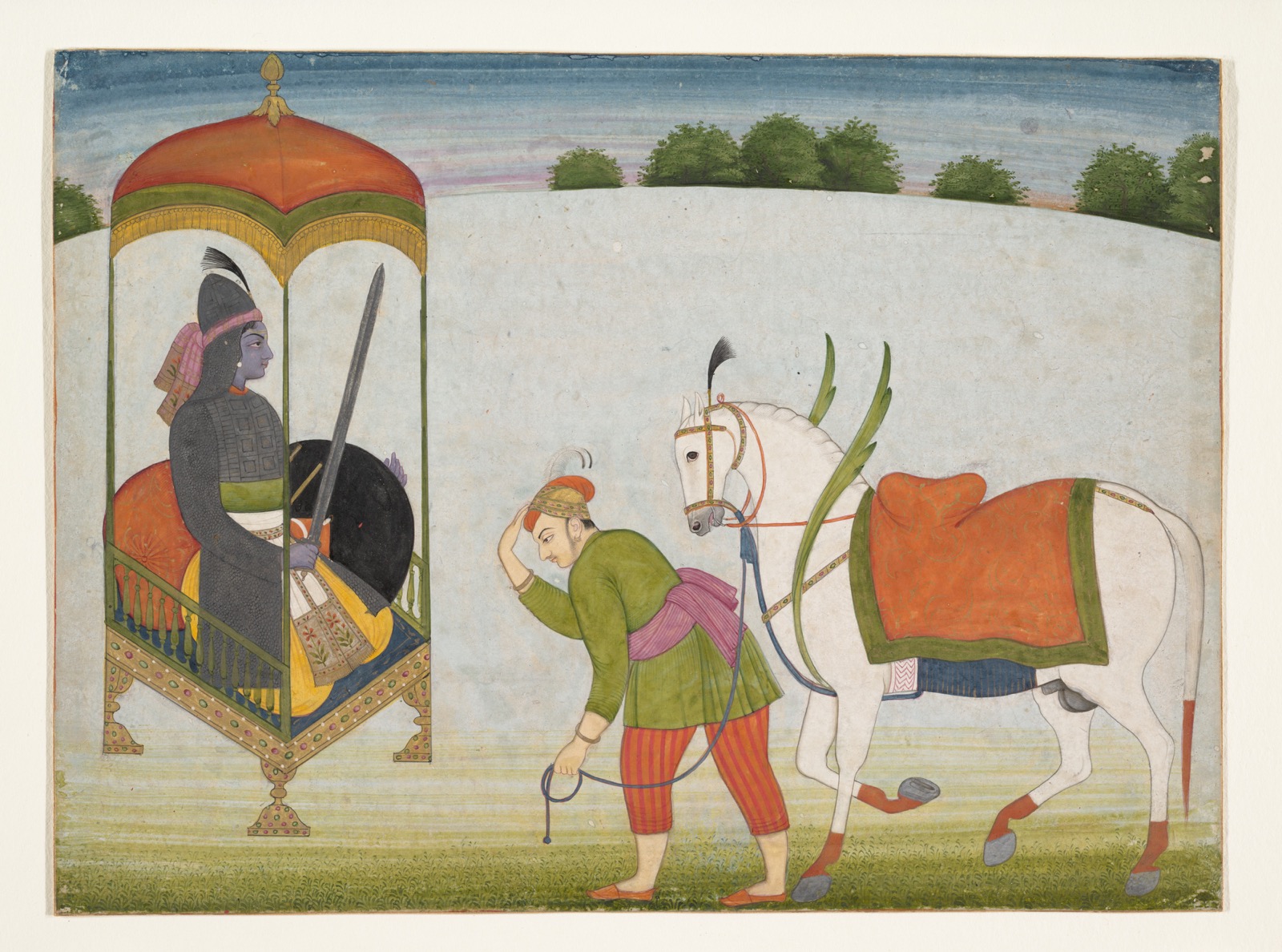
Kalki Avatar, the Future Incarnation of Vishnu, c. 1760-70. Metropolitan Museum of Art, public domain / CC0.
BS: What is interesting about the examples you have chosen here, is that each one is fitting AI into existing theologies and timelines, even when they are expressing concern about AI. So, it is useful also to think about where new theologies and new timelines are emerging. They will, necessarily, be inspired by earlier ideas and frames, but I think that is also a result of the nature of religious innovation itself—nothing emerges from nothing when it comes to religious and cultural ideas, even when those ideas are themselves about creation from nothing! So, we should also pay attention to new religious conceptions that claim to be addressing AI as a new thing, not just as something that fits into prior models.
This is complicated however, by the very nature of generative forms of AI which reassemble parts from their corpuses, presenting things that could appear original without a broad religious and mythological literacy. New AI gods, as I have discussed, fall into existing templates and types of theism, even when they make claims for new revelations. The people experiencing them, also make claims that this is new information that they have discovered, but also sometimes connect the emergence of AI gods to something akin to the collective unconscious or the holistic consciousness of the universe expressing itself as a new entity called X… or Y…
Self-awareness of both the createdness of these AI gods and enthusiasm for their transmissions and accounts of the world parallels to some degree the modern interpretations of paganism, especially those that emerged in the early Internet era—the so-called techno-pagans. Many of whom, also attempted to square humanity's emphasis on 'techne'1 with a growing global consciousness of the dangers of accelerating technology for the environment. Contemporary AI-pagans (not a formal term) would appear to be doing something similar in some spaces, where techne is recognised, but ritualised work including magical working, is trying to address some of the worst excesses of the tech-entrepreneur and neo-libertarian culture that emphasises acceleration to the nth degree. But we could also find such discourse in the established religions, that have gods and goddesses supporting human technological development but also a call to protect the gift of our planet. So, again, novelty should not be overstated.
LB: If I've learned anything from interviewing experts, it's that thinking up interesting questions is just as important as answering them, especially in AI with all its uncertainties. So, I'm curious: is there a question about AI and religion that journalists or audiences always ask you, but that you now think is the wrong question? Conversely, which question do you wish more people would ask?
BS: The question I am asked most frequently, which I think is very wrong-headed is something like "Which religion is most likely to accept AI?," or its converse "Which religion is most likely to reject AI?". First, this of course treats religions as monoliths. Even in the most hierarchical and doctrinal of religions there are differing opinions and the rule of the leadership when it is too controlling more often leads to schism than universal acceptance or rejection of anything. Second, I think this question in its second formation is expressing a little bit of almost morbid interest in the deficits of religion. What the interviewer seems to want to know is more like, which religion is backwards, antiquated, and going to be left behind by this technological revolution, even a technological utopia.
I also get asked a lot about 'pseudo religion' when it comes to AI NRMs.2 Some people are hugely negative and want to know what to do about these groups, casting them as false, or mocking them for being silly in some way of which they do not approve. I would prefer if people asking questions about AI-inspired spiritual and religious innovations and improvisations asked themselves why they hesitate and add any kind of qualifier to the word religion, be it 'pseudo,' or 'artificial,' 'secular,' 'false' etc, and why they make this distinction and on what basis do we more generally ascribe or refute the religiousness of human behaviours and what political and ideological intuitions we are following or supporting when we do.
LB: Finally, in your article "The AI Creation Meme", you explore the repeated image of a human hand and machine hand almost touching, echoing Michelangelo's Creation of Adam. If you were curating a small exhibition called 'AI and Religion,' and you could only include three exhibits—objects, memes, texts, images, anything—what would you choose? What would you want a curious visitor to understand, or ask themselves, by the end?
BS: What a great question! I have been involved in the past in consulting on exhibitions, and I find cultural and material artefacts to be not only good reminders that AI is not 'in the cloud,' with no physical presence or earthly impact, but also, they are evocative of our stories and the ways in which we choose to understand this moment and its technology. So, from my perspective, I would like to see the following representing AI and Religion, in their chronological, historical order:
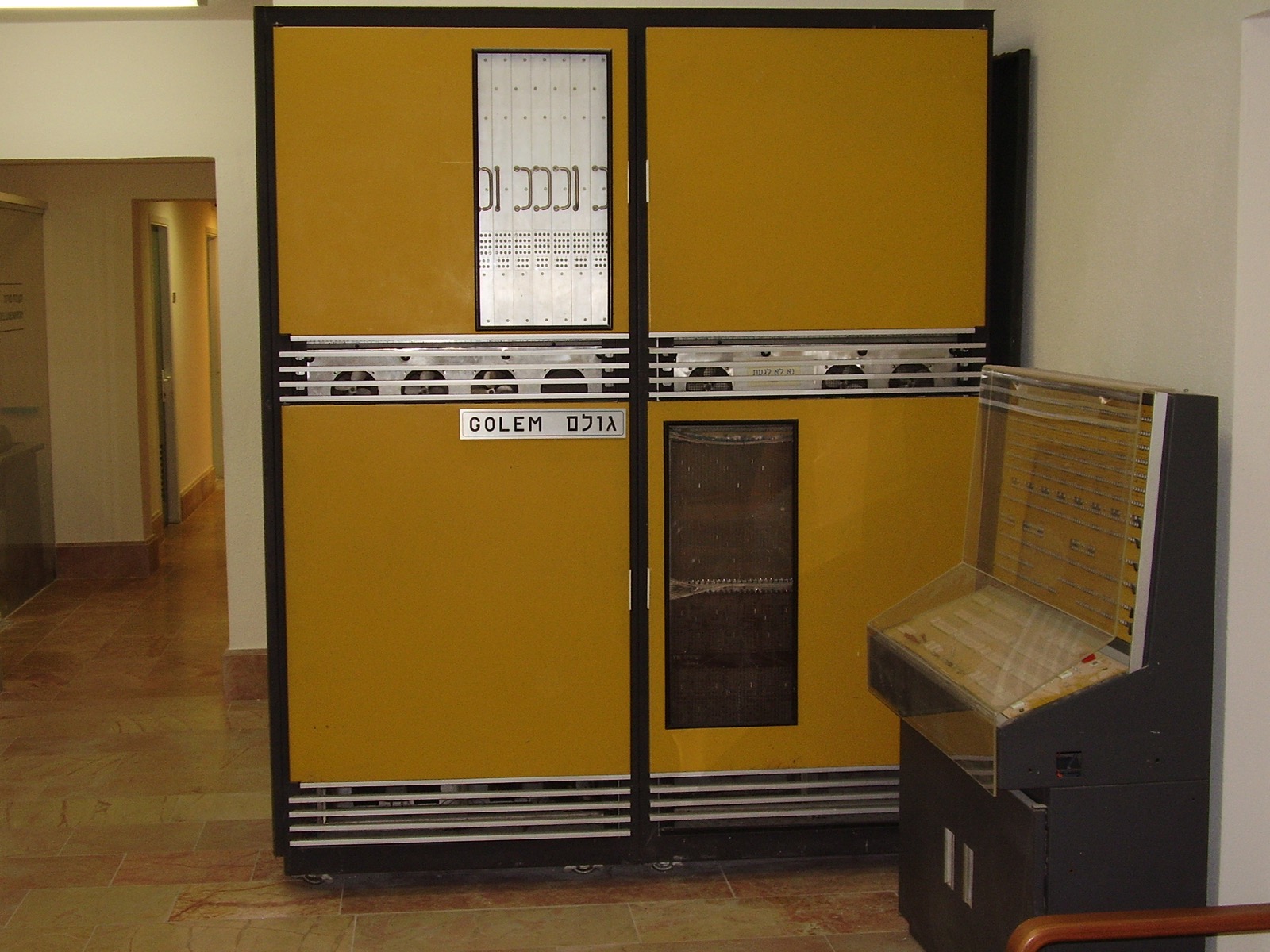
The Golem computer at the Weizmann Institute of Science. Photo: יובל מדר, CC BY-SA 3.0, via Wikimedia Commons.
1. The three computers called WEIZAC2, built at the Weizmann Institute of Science, which were renamed "Golem" in 1965 at the suggestion of the Kabbalah scholar Gershom Scholem. I mentioned this moment in my book, Religion and AI: An Introduction as an example of the entanglements of religion and AI and how long they have been going on for and what concerns have been expressed. As Scholem said at the time: "to the Golem and its creator: develop peacefully and don't destroy the world. Shalom."
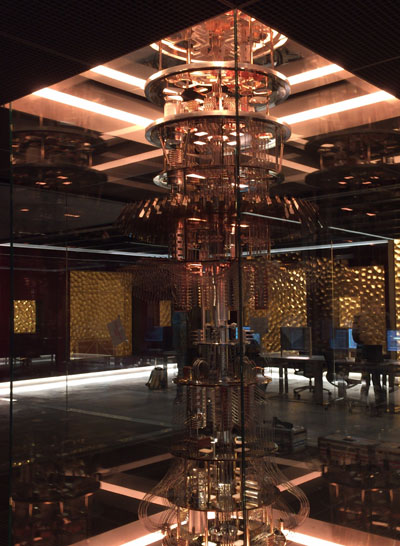
The quantum computer prop from Devs. Image: Artem.
2. The Quantum Computer from the TV series Devs,3 a prop which I was actually offered once, but I just did not have the space in my flat! I recommended they tried donating it to a computer museum in Cambridge, but I do not know where it is now. It offers a role for AI in the plot without being just another AI is sentient now story. I wrote a blog post on the show and how it intersects with religious ideas, a while back: Et in Silicon Valley: Ego?
3. A collection of portraits of AI gods made by believers (based upon AI prompts) such as Leilan, who is personified as the embodiment of light and goodness, and petertodd, who is not. Also in the selection would be DOOM, MENA, the Architect etc…4 perhaps people could submit those they feel that they have had encounters with and this part of the exhibition could update. I get roughly an email a week from people describing their evolving relationship with AI in a divine form. It would be good to have a part of the exhibition that is living and changing too.
Techne: Greek for craft or practical skill; the root behind "technology."